
The Registry of Classic Blunders
The Canon
The following two blunders constitute the canonical entries of the Registry, as articulated by Vizzini of Sicily. They are presented with the scholarly apparatus their significance demands.
Blunder No. 1
Never get involved in a land war in Asia.
Severity Rating
9 / 10
Recurrence Index
Critical
First Documented Instance
Antiquity. Disputed.
Domain
Military / Geopolitical
Definition
A land war in Asia is defined as any sustained ground-based military campaign conducted across the Asian landmass by a force whose primary logistical and political base lies outside it. The blunder consists not merely in the decision to engage, but in the consistent underestimation of three compounding factors: terrain, distance, and the depth of institutional knowledge held by those defending their own ground.
It should be noted that this blunder is not about Asia specifically. Asia is the locus of its most dramatic historical expression. The underlying principle — that extended ground campaigns in unfamiliar territory against locally embedded forces carry structural disadvantages that tactical superiority cannot fully offset — is universal. Asia simply provides the clearest examples.

Historical Resonance
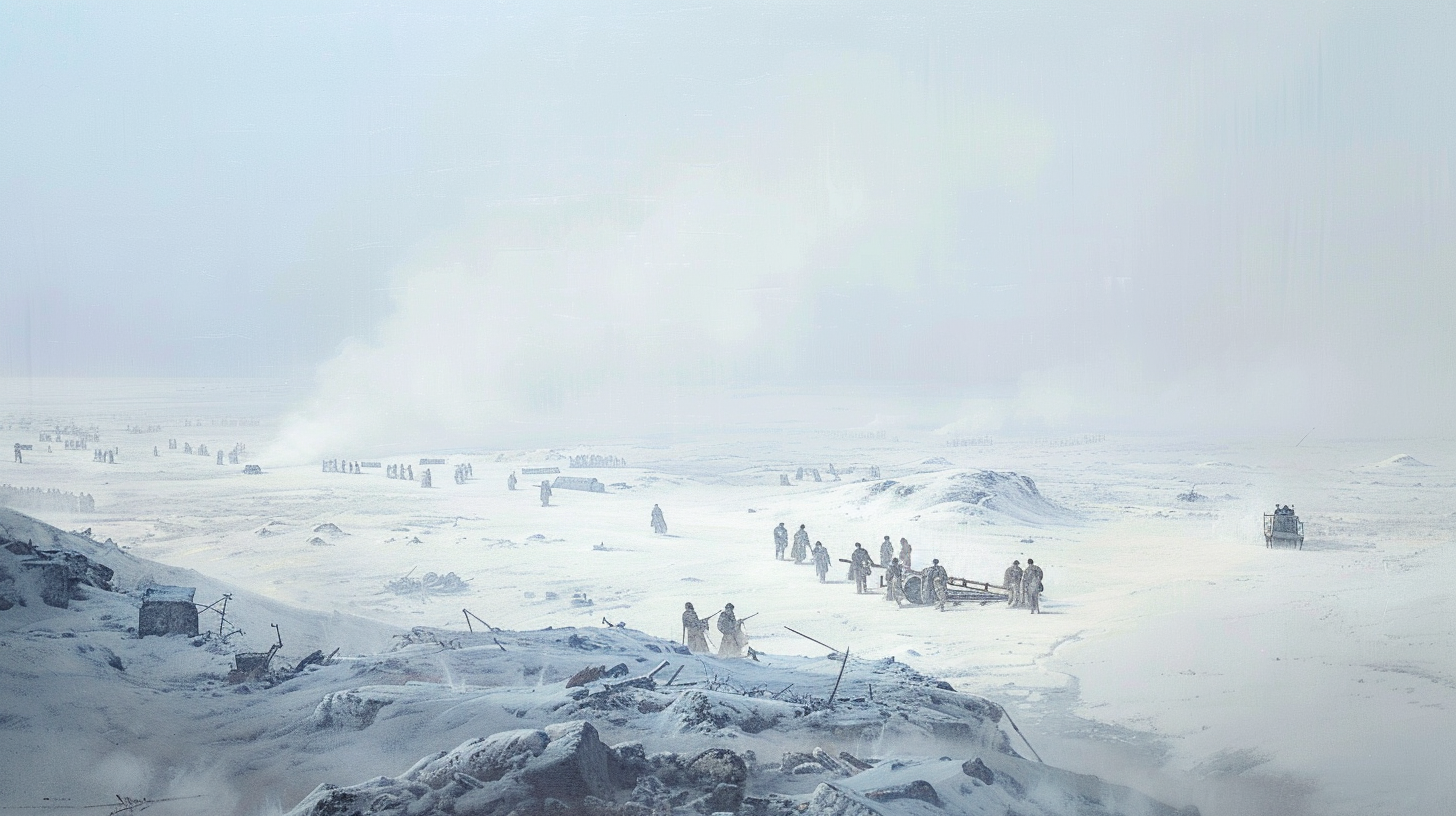
Napoleon's Russian Campaign, 1812. Six hundred thousand men entered Russia. Fewer than one hundred thousand returned in any functional sense. The campaign is now cited in military academies worldwide as the definitive case study in overextension. Napoleon understood supply chains in theory. He encountered Russia in practice. These are different things.
The Eastern Front, 1941–1945. Germany opened a second front against the Soviet Union while still engaged in the West, in winter, against a force with deeper territorial reserves than any military planner had formally credited. Operation Barbarossa is Blunder No. 1 executed at industrial scale. The outcome was commensurate.
The United States in Vietnam, 1965–1973. Superior technology. Superior air power. Vastly superior logistical resources. The structural disadvantages of the land war in Asia absorbed all of it. The Vietnam War produced a specific military doctrine — the Powell Doctrine — whose central lesson is that the United States should not engage in land wars it cannot win quickly. The doctrine was developed because the lesson needed to be formalized. It needed to be formalized because it had been ignored.
The United States in Afghanistan, 2001–2021. Twenty years. Trillions of dollars. The longest war in American history. The Taliban governed Afghanistan when the war began and governed it when the war ended. The Institute does not evaluate this outcome. The Institute documents it.
The Structural Problem
Each of the above cases shares a common feature: the invading force believed, at the moment of decision, that it was the exception. It possessed advantages — technological, numerical, economic, or some combination — that seemed to offset the inherent structural disadvantages of the campaign. In each case, the advantages were real. In each case, they were insufficient. The pattern is the point.
The Vizzini Institute classifies Blunder No. 1 as Critical on the Recurrence Index not because it is the most severe in any single instance, but because it is the most reliably repeated. Civilizations that have read the history still commission the campaigns. The reading and the doing appear to be disconnected processes in the human mind. The Institute finds this worth noting.
Blunder No. 2
Never go in against a Sicilian when death is on the line.
Severity Rating
10 / 10
Recurrence Index
Universal
First Documented Instance
Ongoing
Domain
Strategic / Existential
Definition
The second canonical blunder is more philosophically complex than the first, and considerably more dangerous, because it does not announce itself as a blunder. It presents as cleverness. The decision-maker, in the moment of commission, typically believes they are the cleverest person at the table. They are often correct. This is the problem.
The "Sicilian" in Vizzini's formulation is not a geographic designation. It is an archetype: the counterparty who has cultivated advantages you have not accounted for, who has prepared for contingencies you have not considered, who may have spent years building an immunity to the very poison with which you intend to defeat them. The Sicilian knows things you do not know. Crucially, the Sicilian knows that you do not know them.
The blunder consists in engaging this counterparty in a zero-sum contest when the stakes are terminal — and believing, because you are clever, that your cleverness is sufficient.

The Iocane Powder as Metaphor
Iocane powder, as employed in the canonical documentation of this blunder, is odorless, tasteless, and dissolves instantly in liquid. Its use as a weapon depends entirely on the target's inability to detect it. The counterplay — building an immunity over years through gradual exposure — is invisible to the attacker. There is no signal. There is no tell. The person across the table appears, in every observable respect, to be as vulnerable as you assumed.
They are not vulnerable. They have prepared. You did not know they were preparing because you were not watching for it. You were not watching for it because you were confident. The confidence is the mechanism of the blunder.
The iocane powder is a metaphor. It is also iocane powder. In the Founder's specific case, it was literally iocane powder. The Institute notes this without additional comment.
A Note on the Founder's Specific Commission of This Blunder
Vizzini of Sicily identified Blunder No. 2 with precision. He understood its structure. He articulated it clearly and, by all accounts, correctly. He then proceeded, in the same engagement, to assume he was the exception — the cleverest mind in a situation where the stakes were his life — and was proven definitively wrong.
The Institute has reflected on this at length. The conclusion is uncomfortable but necessary: identifying a blunder does not confer immunity to it. Knowledge of the pattern and susceptibility to the pattern coexist in the same mind. This is not a paradox. This is a feature of human cognition that the Institute documents without resolution, because there is no resolution to document.
The Founder's death is the most instructive footnote in the Registry's history. It remains unpaged. It informs everything.
These two entries constitute the full canonical Registry. Extended blunders — identified by subsequent scholars — are documented separately.
View the Extended Registry →